A product of BEAS Solution

Generic AI Report

Ask your data. Ship the answer.

Register a workspace. Run reports on OpenSearch — either the free, limited BEAS Resource tenant or your own cluster. Chat uses your LLM access token. Feed data from MySQL, PostgreSQL, MongoDB, files, or live OpenAPI APIs.

Free Standard plan includes a limited BEAS Resource OpenSearch tenant. AI calls go through your own access token.

Capabilities

From a question to an operating board

One platform for ad-hoc answers, forecasts, reusable analytics, live APIs, and governed data prep — without moving your data out of your control.

Natural-language report

Ask in plain language. Get text, HTML, tables, charts, or KPIs — then save strong answers as widget drafts, mail drafts, or RAG examples.

Widgets & shared metrics

Build a library of ECharts, tables, and HTML widgets. Share dashboard queries so one metric definition drives many boards.

Executive dashboards

Drag-and-drop layouts with a common date range, cross-filters, drill-down, live or frozen share links, and export to PDF or Excel.

AI Guide grounding

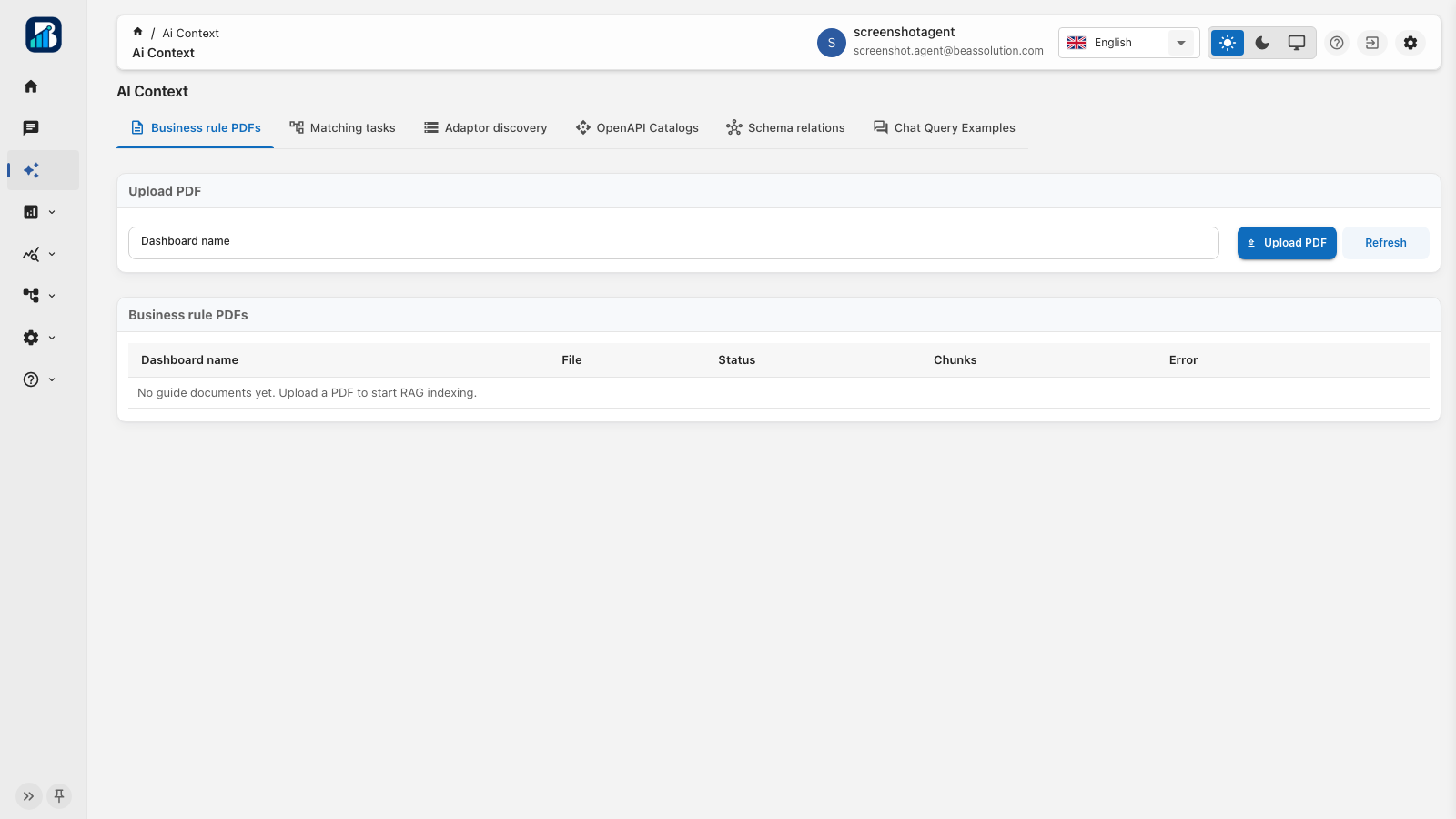
Upload approved policy PDFs and index dictionaries so answers stay aligned with how your business actually works.

Data prep & adaptors

Reporting always queries OpenSearch. Fill it from PostgreSQL, MySQL, MongoDB, CSV, and Excel — with PII controls and approval gates.

Anomaly monitoring

Schedule detectors, triage incidents, and keep human approval before any operational write from chat-driven drafts.

Forecast with consent

Ask for an outlook in Report. Review the plan, approve sample-document consent, then see history versus predicted values in the same thread.

Live HTTP APIs

Register OpenAPI catalogs. Report talks to your services through the OpenAPI MCP server — list, get, summarize; writes wait for Approve / Reject.

Schema & query RAG

Publish index relationships and successful chat examples so the assistant plans multi-index answers from your approved graph — not guesses.

How it works

Register. Connect. Operate.

Create a workspace on the Standard plan, bring your own LLM and OpenSearch, then invite the team. Identity stays with you — role-based access, invites, package limits, and full audit trails.

  1. 01

    Register

    Create a workspace, verify email, and sign in. The owner becomes Tenant admin. Join later through an invitation.

  2. 02

    Connect

    Add your LLM provider and token. Choose the free BEAS Resource OpenSearch tenant or point at your own cluster. Test connections, then unlock Report.

  3. 03

    Operate

    Ask, save widgets, forecast with consent, publish schema RAG, assemble dashboards, and keep every view and export in the audit log.

Start here

From registration to your first answer

Each customer owns a workspace. Create an account on the free Standard plan, verify email, add your LLM token, choose BEAS Resource or your own OpenSearch, then ask questions in natural language.

Getting started

What you can do

Ad-hoc questions in Report, consented forecasts, reusable widgets, executive dashboards, shared metric DSL, OpenAPI catalogs, schema analytics, query examples, anomaly monitors, data prep, file ingest, AI Guide grounding, and full audit trails.

  1. Register a workspace and verify email
  2. Sign in, add your LLM token, then choose BEAS Resource or your OpenSearch
  3. Invite teammates; publish schema and query examples when ready

Accounts

Username & password SaaS login

Create a workspace on register, or join through an invitation. Email verification is required before the first sign-in. The registration owner becomes Tenant admin on the Standard plan.

  • Workspace name, email, username, password
  • Verify via inbox link or resend from verify-email
  • Forgot / reset password when mail is configured

Workspace

Your AI token. Your cluster — or ours, limited.

Report chat and live dashboards unlock only after LLM and OpenSearch tests pass. Secrets are encrypted at rest and never shown again. The platform does not bill your LLM provider.

Your LLM access token

Every chat call uses your key

Step 1 of setup is the model endpoint you already pay for. Generic AI Report stores the token encrypted in your workspace and sends it only to the URL you configure. We do not share a platform OpenAI pool.

  • OpenAI — paste your API key, chat and embedding models
  • Ollama or any OpenAI-compatible server — your base URL (for example an internal GPU box)
  • Leave the key field blank on later saves to keep the stored secret

OpenSearch for reporting

BEAS Resource or your own servers

Chat, widgets, dashboards, forecasts, and RAG all query OpenSearch. Choose the free hosted BEAS Resource tenant, or connect an external cluster you operate.

  • BEAS Resource — isolated tenant, 50 MB, 10 indices, no URL or password to type
  • External — your OpenSearch URL, username, password, optional lab TLS
  • Both tests OK → setup complete and the product unlocks

Data sources

OpenSearch is the reporting engine. Everything else feeds it — or answers live.

Dashboards and chat do not query MySQL, PostgreSQL, or MongoDB directly. Those systems are source databases: Data Prep copies or transforms rows into OpenSearch indices. Live HTTP APIs are a separate path through OpenAPI catalogs and MCP.

Reporting store

OpenSearch indices

Every widget DSL, chat aggregation, forecast series, anomaly monitor, and AI Guide chunk runs against OpenSearch. Indices can live in the limited BEAS Resource tenant or on a cluster you host.

Source databases

MySQL, PostgreSQL, MongoDB

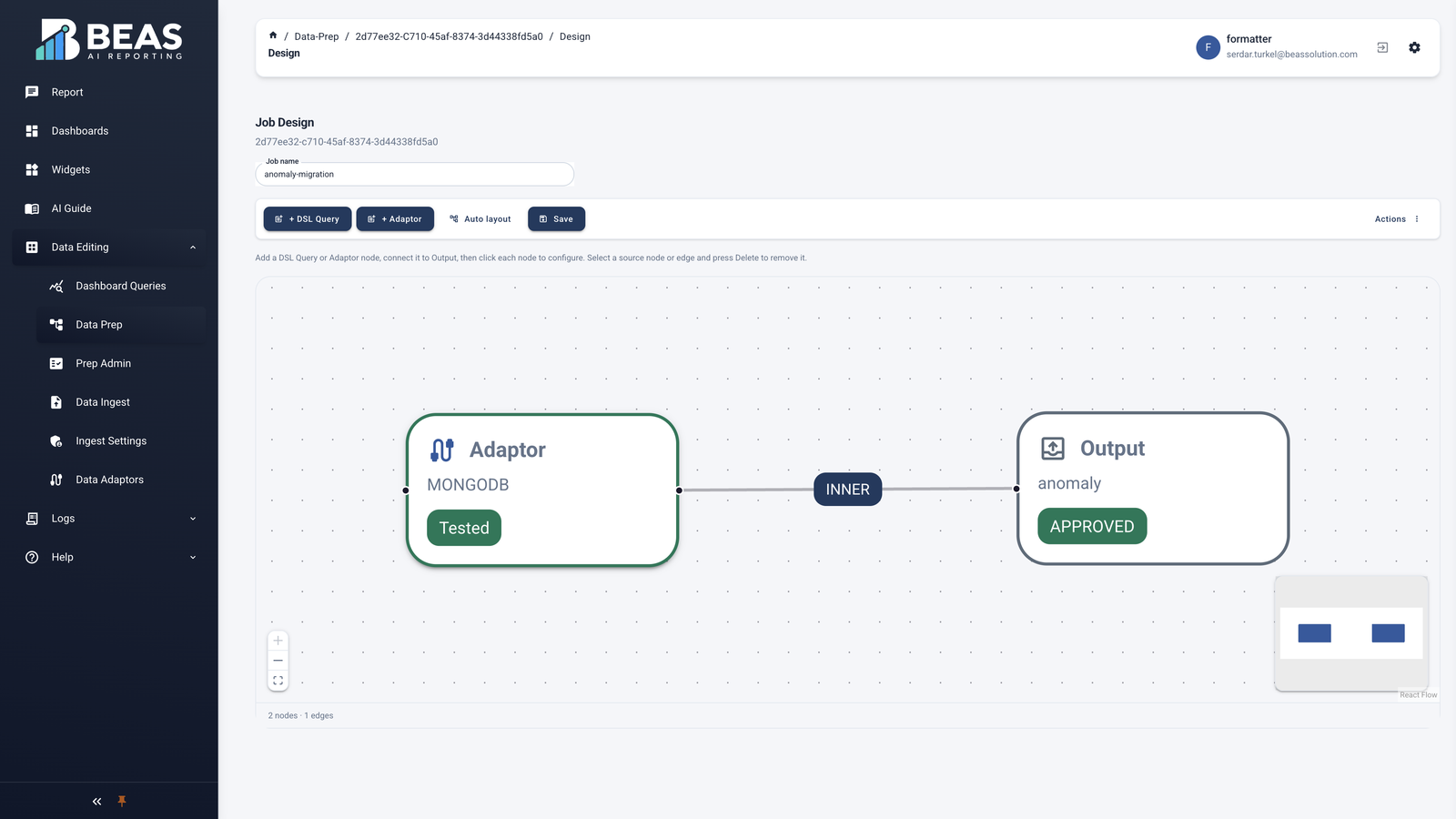
Store encrypted adaptor connections once. In Data Prep, draw a graph: adaptor node → field mapping / joins → staging or production OpenSearch index. Secrets never land in the published graph JSON. CSV and Excel ingest is the file equivalent of the same pipeline.

Live APIs

OpenAPI catalogs + MCP

When the question is “get order 12345 from our API”, Report does not scan OpenSearch. It routes to your registered HTTP API through the OpenAPI MCP server.

OpenAPI MCP path

How Report reaches your services

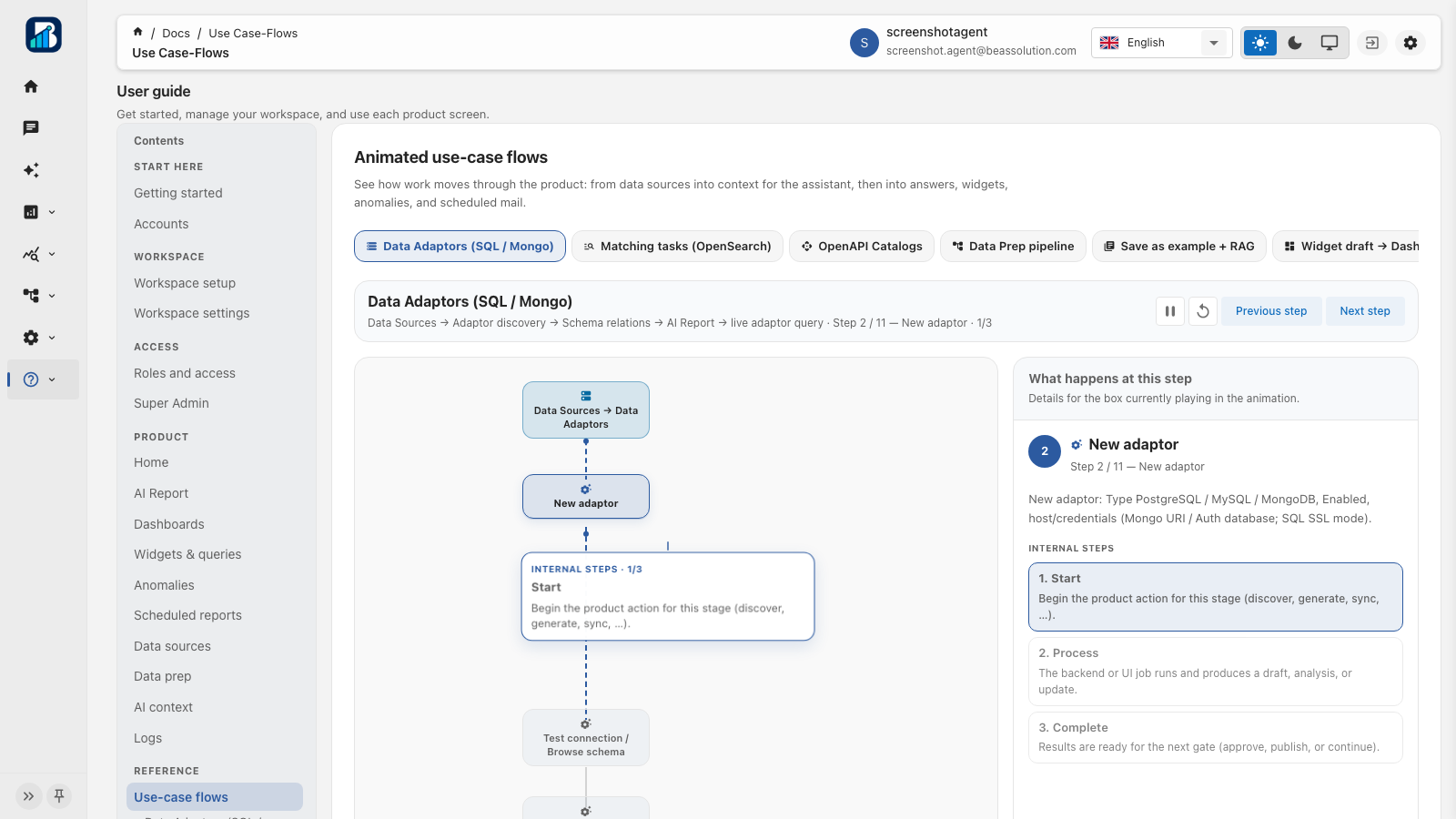
Tenant admins register catalogs under OpenAPI Catalogs with a public OpenAPI document URL and the production API baseUrl. Report refreshes a snapshot of tags and operations. In chat you can pin a catalog and tag; the orchestrator then calls tools on the workspace MCP endpoint.

  1. You ask in Report (optional catalog / tag chips)
  2. Chat tools talk Streamable HTTP /mcp with your login JWT — MCP does not mint tokens
  3. openapi-mcp selects catalog → tag → operation, then calls your API
  4. Reads (list / get / summarize) return in the thread; writes become a mutation-draft card until you Approve or Reject

What MCP is for

Operational APIs, not the warehouse

Use OpenAPI when the source of truth is a live service (orders API, inventory, ticketing). Use Data Prep + OpenSearch when you need history, aggregations, dashboards, and forecasts. Both can sit in the same workspace; the resource router picks the path from the question, or you bind it manually.

  • Catalog CRUD is admin-only; chat roles can call enabled catalogs
  • Patches never apply until a human approves the Before / After card
  • Your API stays on your network; MCP forwards the browser session JWT

Product

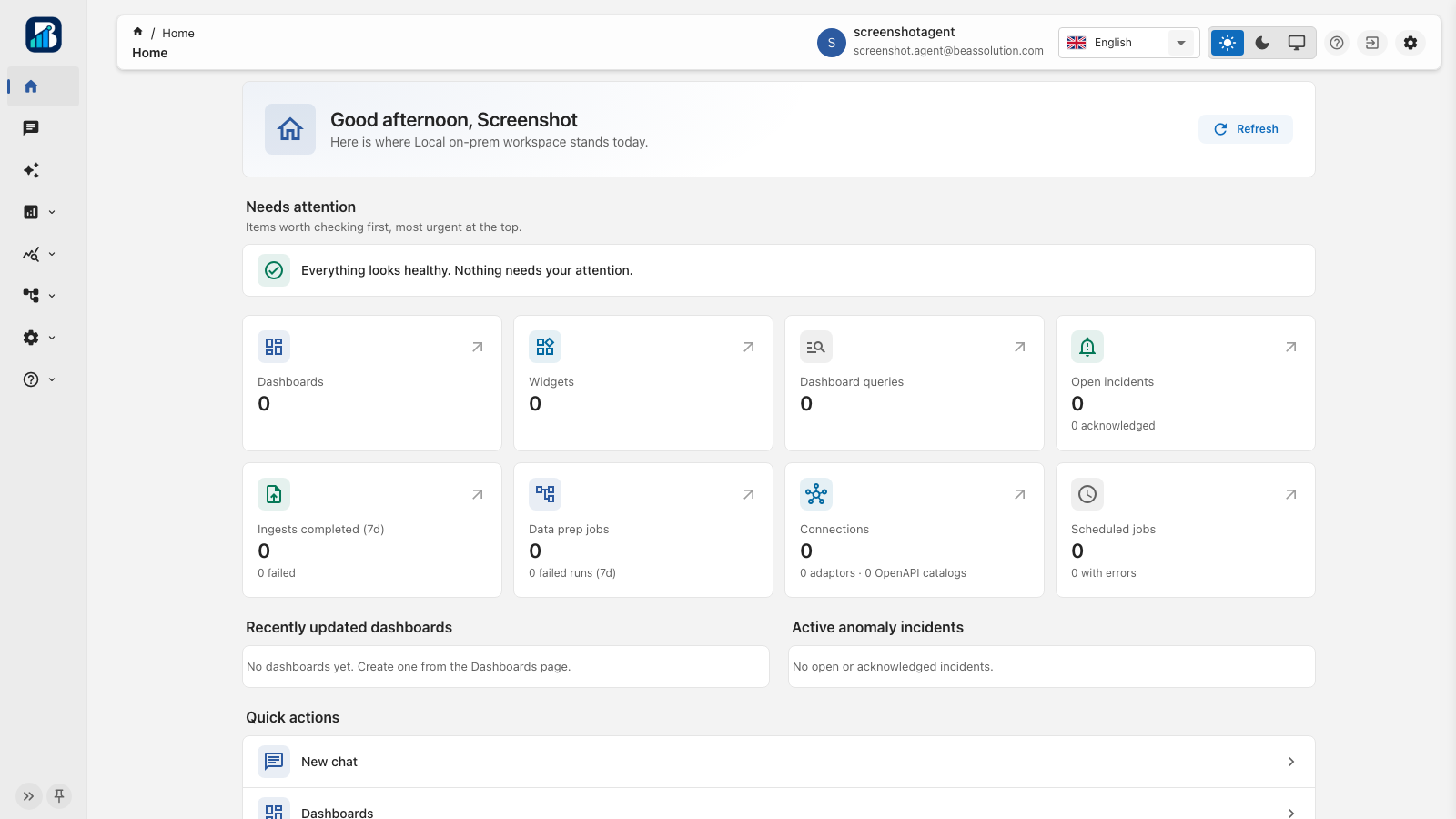
Screens that turn questions into operating boards

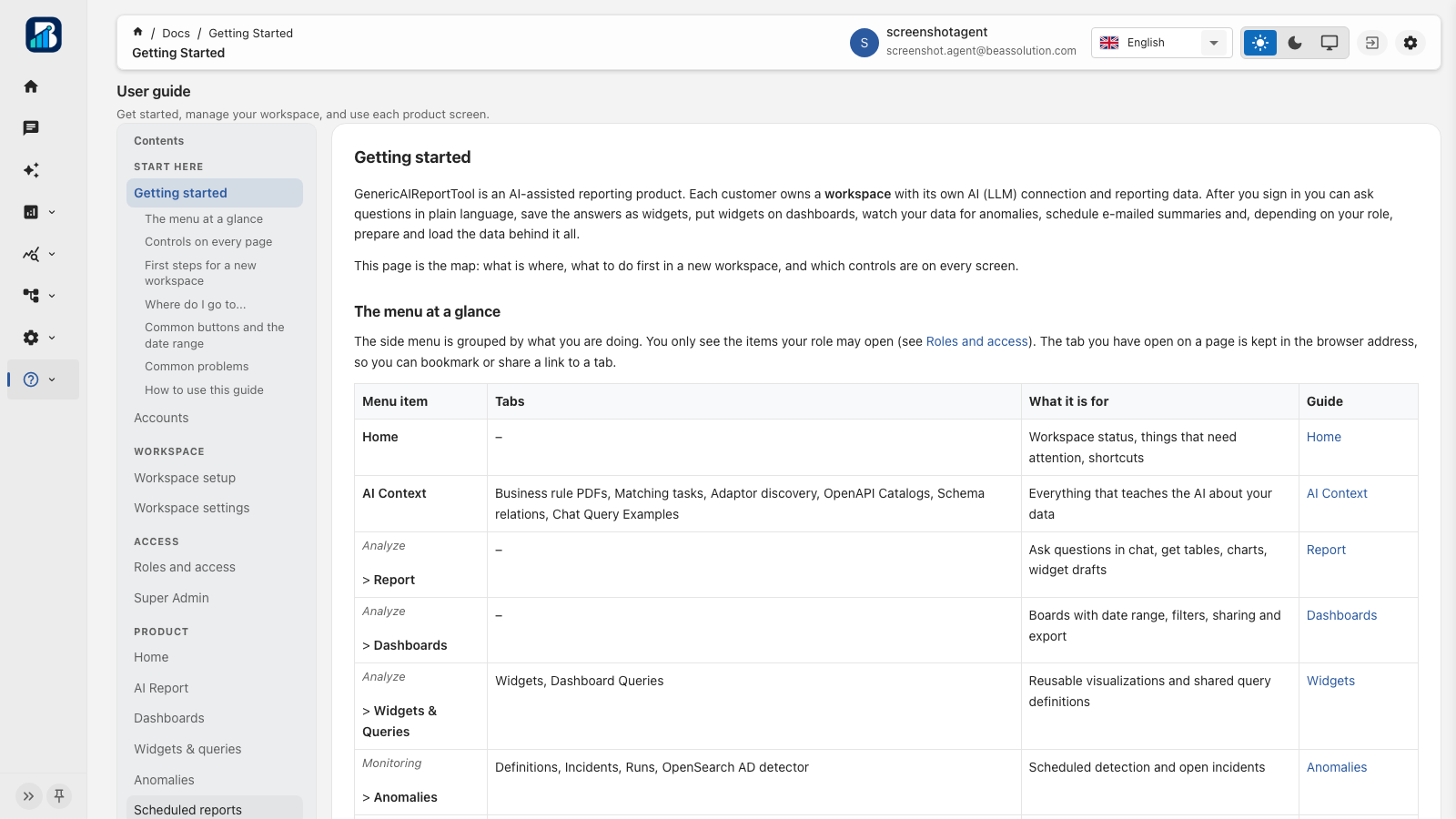
Real product screens from Generic AI Report — Report, forecasts, widgets, dashboards, governed data paths, schema RAG, and workspace setup.

AI Report

Natural-language workspace

Ask against OpenSearch with optional index scope and output preference. Get text, HTML, tables, charts, or KPIs; answer clarifications; save widget drafts; promote query examples to RAG; use history, voice input, and print.

Forecast

Outlook in the same thread

Ask for a prediction. Review method, index, and time field; approve sample-document consent; then inspect history versus forecast bars without leaving Report.

OpenAPI catalogs

Registered HTTP APIs via MCP

Admin registers an OpenAPI document and API base URL. Chat selects catalog and tag, then openapi-mcp executes the operation with your login JWT. List/get/summarize return in-thread; patches wait on Approve / Reject.

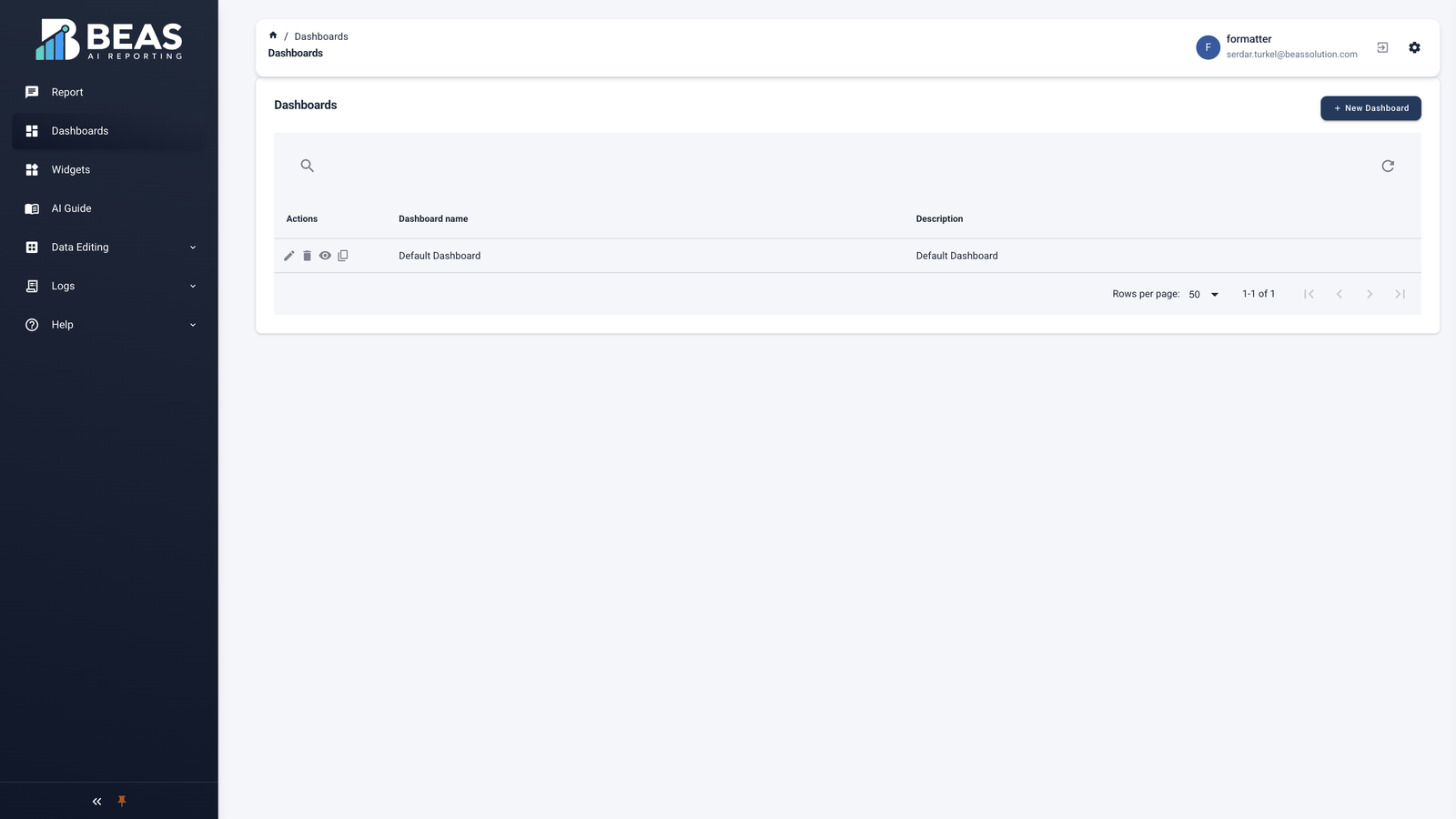
Dashboards

Executive boards

Combine widgets and decorations with layout presets, a shared date range, cross-filters, drill-down, live or frozen share links, and PDF / Excel / email export.

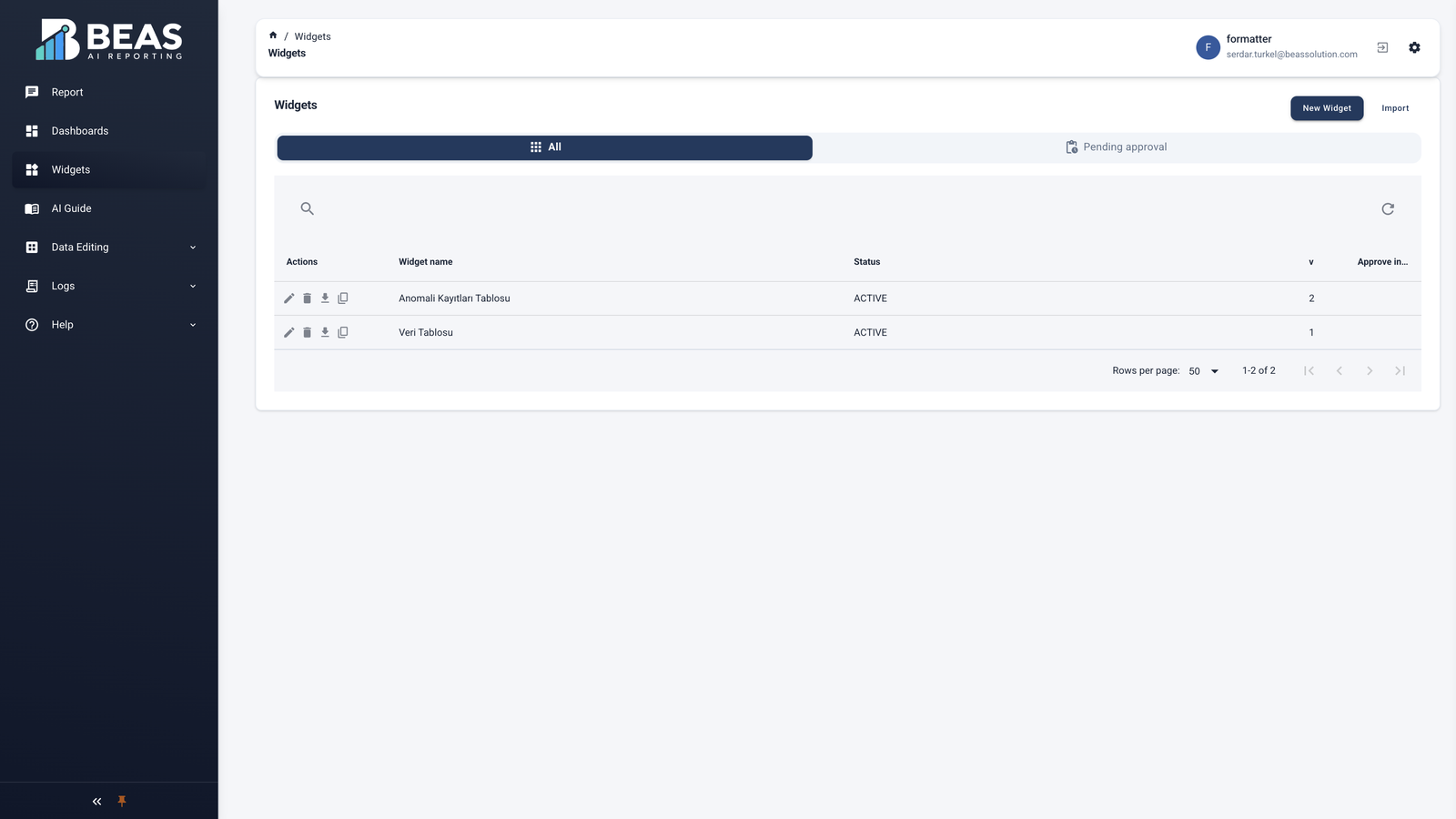
Widgets

Reusable visualizations

Library of ECharts, tables, text, and HTML widgets with studio, versions, import/export, mapping hints, and admin index approval for pending definitions.

Dashboard queries

Shared metric DSL

One validated query definition referenced by many widgets — keep executive metrics consistent across boards.

Anomalies

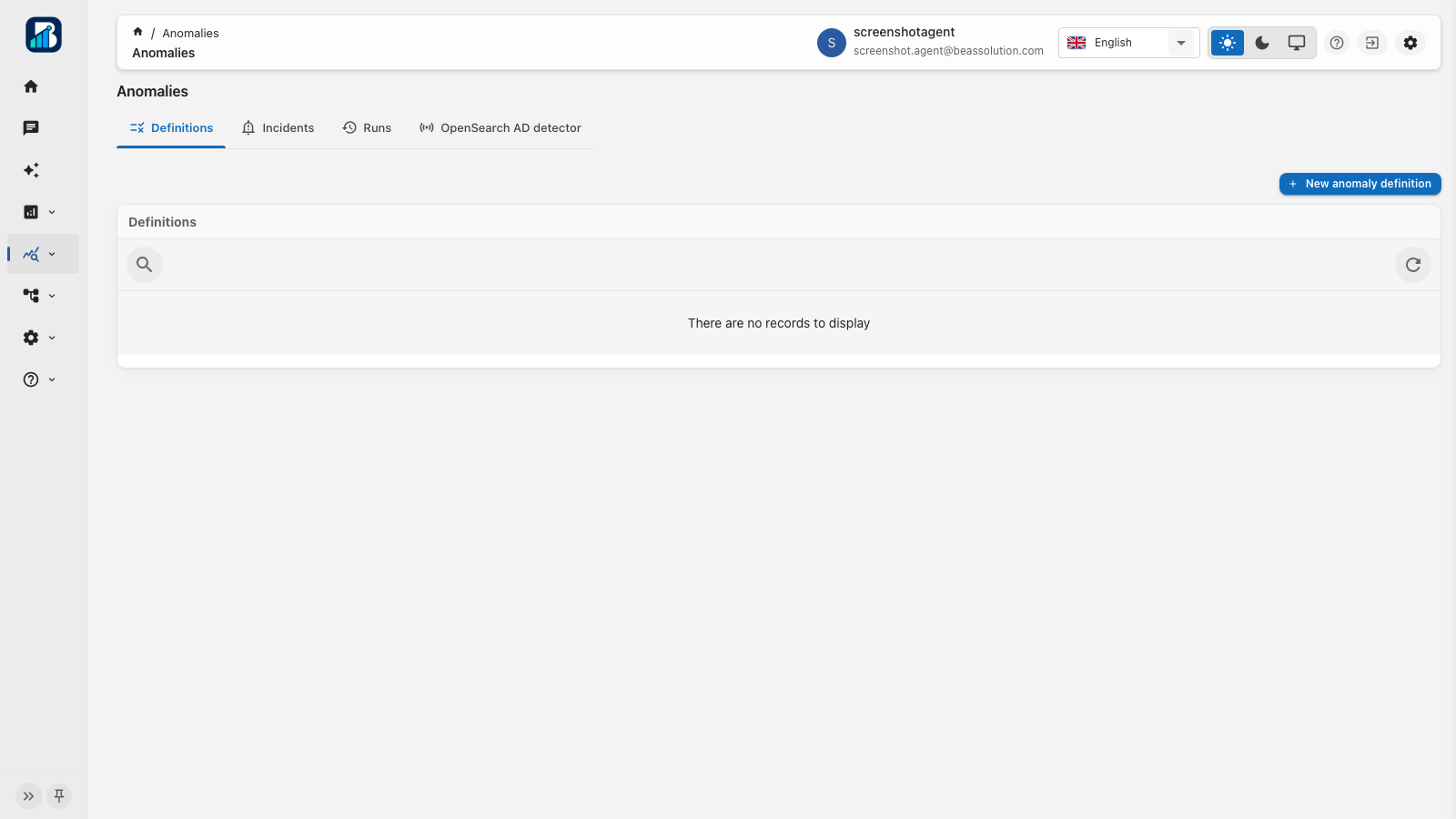
Scheduled detection

Define monitors, run now or on schedule, triage open incidents, and keep human approval before chat-driven operational writes.

Data prep

Visual pipelines

Read from MySQL, PostgreSQL, or MongoDB adaptors (or from OpenSearch), map fields across a graph, and write staging or production reporting indices that chat and widgets query.

Ingest

CSV / Excel under governance

Load files into granted indices with staging or production environments, bulk size control, PII rules, schemas, and job-level failure detail.

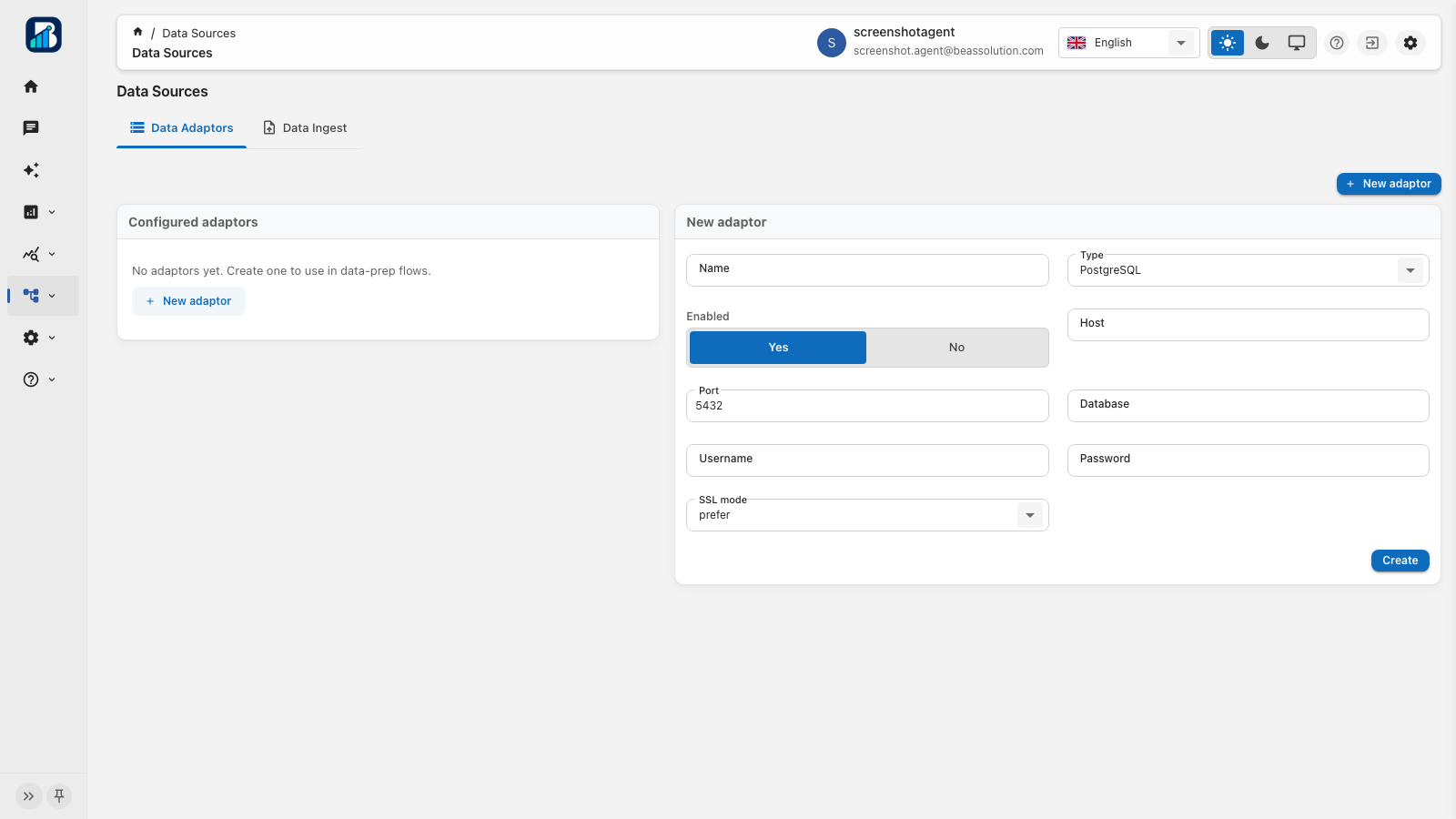
Data adaptors

PostgreSQL, MySQL, MongoDB

Store encrypted connection settings once; Data Prep adaptor nodes reference the id — passwords never land in published graph JSON.

AI Guide

Ground answers in policy

Upload business-rule PDFs and approve index-mapping analyses so Report cites approved RAG chunks instead of guessing field meanings.

Data structure analytics

Cross-index relationships

Analyze approved Guide mappings into a graph of purposes and joins. Enrich with consented samples, then publish to RAG so chat can plan multi-index questions.

Chat query examples

Successful questions as RAG

Promote a strong chat result into a reusable example — question, indices, and DSL — so later turns follow proven patterns instead of starting from scratch.

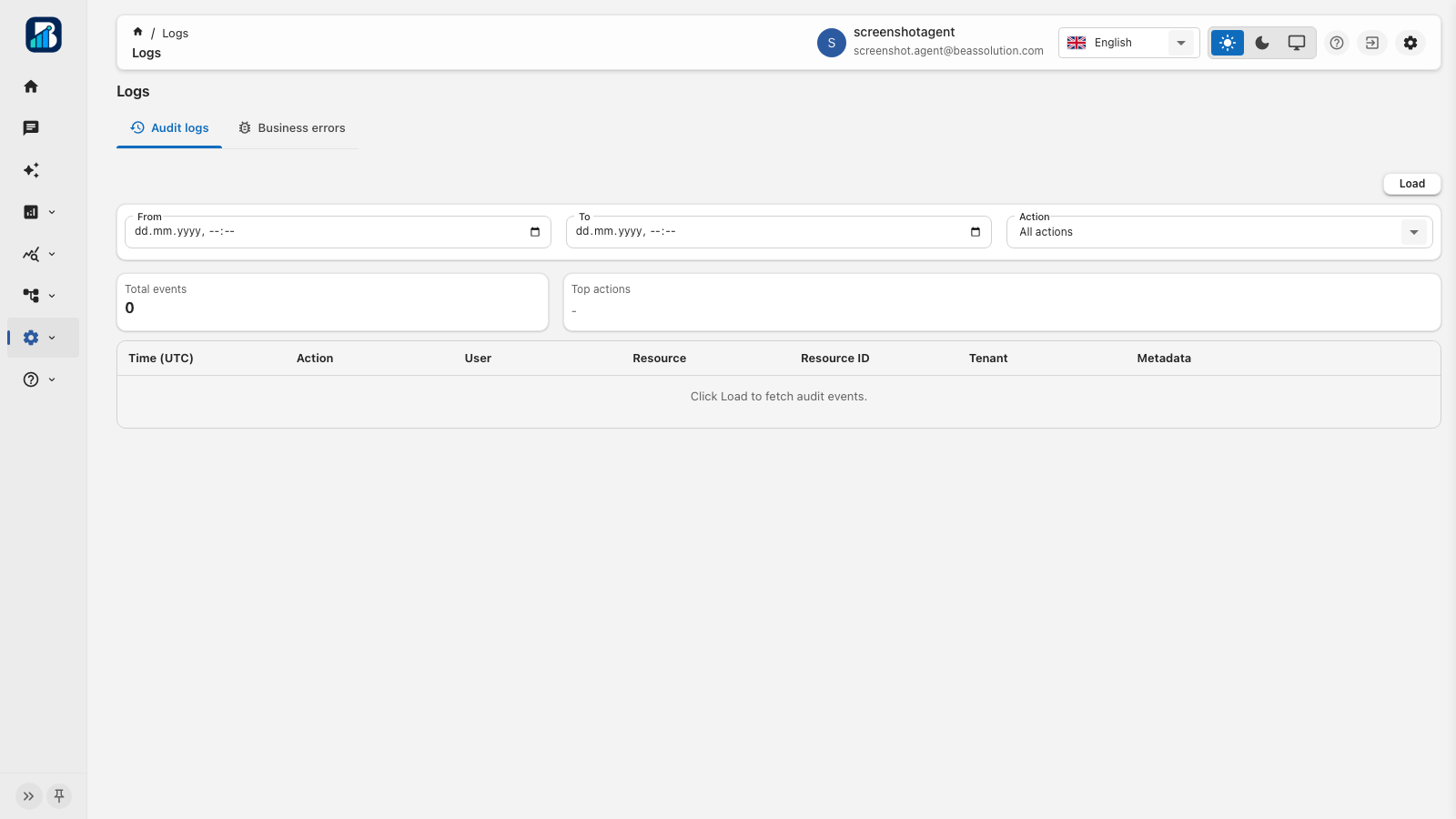
Logs

Audit & business errors

Trace who viewed, exported, or changed configuration. Investigate business exceptions with filterable admin tables.

Access

Roles that match how teams actually work

The sidenav hides what you cannot use; the API still enforces access on every request.

Roles and access

Workspace roles

Tenant admin Setup, credentials, invites, approvals, all product menus
User Analyst builder — Report through schema analytics, data prep, adaptors, and logs
Reporter Report, forecasts, dashboards, widgets, shared queries, and query examples
Viewer Open Report and boards in view mode — no create, edit, share, or export

Super Admin

Platform operators

Platform admin users land on the Super Admin portal — not tenant Report. They manage packages, mail, every workspace’s BYO settings, users, invitations, and operational logs.

  • Platform dashboard — users by package and expected MRR
  • Assign Standard / Business / Business+ / Enterprise; record manual payments
  • Mail, workspaces, users, invitations, audit logs, business errors

Architecture

Your keys. Your cluster. Our application plane.

A browser SPA talks to a Spring Boot API. Application documents live in MongoDB; files in MinIO. Reporting data lives in OpenSearch (BEAS Resource or yours). Chat embeddings and completions use the LLM token you configure.

Layers

Runtime stack

  • React SPA with role-aware shell and i18n
  • Spring Boot API, REST + STOMP progress
  • MongoDB for product documents
  • OpenSearch — BEAS Resource tenant or your cluster
  • Your LLM token for chat, forecasts, and embeddings

Configuration

Workspace-scoped BYO

LLM provider, base URL, API key, and models are always yours. OpenSearch is either the limited BEAS Resource tenant or your URL. Package limits apply to users, AI analysis length, guides, adaptors, jobs, catalogs, widgets, and boards.

Capability catalog

Visible screens, mapped APIs

Accounts, setup, Report, forecasts, dashboards, widgets, anomalies, data prep, ingest, adaptors, AI Guide, schema analytics, query examples, OpenAPI catalogs, logs, packages, and Super Admin — each backed by documented API families under the product context path.

Security & governance

Designed for controlled AI — not shadow IT.

Credentials are encrypted at rest. Secrets never reappear in the UI. Access follows roles. Forecast samples, schema enrich, anomaly writes, and OpenAPI mutations wait for human approval.

  • Encrypted storage for LLM, OpenSearch, and data-adaptor secrets
  • Password accounts with tenant isolation; Keycloak stays off the browser
  • PII redaction, hashing, and partial masking on ingest
  • Consented sample reads for forecasts and schema analysis, with audit trails
Create a workspace

Free on Standard

The application is free. BEAS Resource is free and capped. Your LLM bill stays yours.

Standard includes the full product UI and API, a limited hosted OpenSearch tenant called BEAS AI Report Resource, and package caps on users, widgets, and chat length. Completions always go to the provider behind the token you stored.

What BEAS hosts for free

Application plane

Sign-up, login, workspace shell, Report, dashboards, widgets, Data Prep, ingest, OpenAPI catalogs, audit, and Help. App documents sit in our MongoDB; guide files in MinIO within the plan’s storage cap. No platform LLM credits are included.

BEAS Resource

Limited hosted OpenSearch

Choosing Free BEAS AI Report Resource in setup provisions an isolated tenant on the shared cluster. You do not type a URL or password. Indices are prefixed to your workspace so other tenants cannot see them.

  • 50 MB storage per workspace (soft quota)
  • Up to 10 indices under your prefix
  • Ingest, Data Prep, and chat stop with a quota error when the cap is hit
  • Switch to External OpenSearch any time to use your own servers with no BEAS storage cap

What you still bring

AI access token and optional own servers

Setup always asks for an LLM provider. OpenAI keys, Ollama, or any OpenAI-compatible endpoint you run. Tokens leave our API only toward that URL. MySQL, PostgreSQL, MongoDB, and OpenAPI base URLs stay on your network; we store encrypted connection settings, not your data warehouse.

Plans

Choose the package that fits your workspace

Limits follow the workspace owner’s plan. Chat quota is the AI analysis length. Paid prices are in euro. Annual billing charges 10 months for 12 months of access.

Standard

Free

Includes the limited BEAS Resource OpenSearch tenant. You still attach your own LLM access token. No technical support; tickets ship with the next release.

  • 5 workspace users
  • AI analysis up to 2,000 characters
  • BEAS Resource: 50 MB OpenSearch · 10 indices
  • 50 MB total guide documents
  • 3 data adaptors · 5 jobs
  • 10 OpenAPI catalogs
  • 20 items per ingest settings tab
  • 20 widgets · 5 dashboards · 10 queries
Start free

Business

€2/ month

Annual option: pay 10 months, get 12. All Standard limits ×3.

  • 15 workspace users
  • AI analysis up to 6,000 characters
  • 150 MB total guide documents
  • 9 data adaptors · 15 jobs
  • 30 OpenAPI catalogs
  • 60 items per ingest settings tab
  • 60 widgets · 15 dashboards · 30 queries
Contact sales

Enterprise

Custom

Everything unlimited. Contact us for monthly billing and enterprise terms.

  • Unlimited workspace users
  • Unlimited AI analysis length
  • Unlimited guide storage
  • Unlimited adaptors, jobs, catalogs
  • Unlimited ingest settings
  • Unlimited widgets, dashboards, queries
  • Priority engagement path
Contact us

Ready when your data is.

Create a workspace on Generic AI Report and start with the questions your leadership already asks.

Create a workspace

BEAS Solution

Efficiency through AI

Enterprise software for intelligent automation, document operations, and AI-native reporting — headquartered in Podgorica, Montenegro.

Address Business Tower Montenegro
Bulevar knjaza Danila Petrovica 13/32
81101 Podgorica, Montenegro

Email contact@beassolution.com

Web beassolution.com

Product Create a workspace Sign in